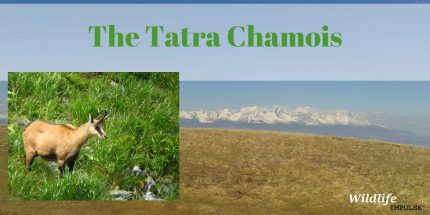
Tatra chamois in Slovakia
Chamois – Rupicapra rupicarpa
The chamois is a goat-like animal with striking contrasting facial markings and elegant, backwards curved, horns. The chamois is native to Europe and can be found in most of Europe’s mountain ranges like the Alps, Pyrenees, Carpathian Mountains (including the Tatra Mountains), And Balkans.
The chamois belongs to the bovid family. A full-grown chamois shoulder height of 70 to 90 cm and about 120 cm long. Males are a bit heavier than females (resp. 30-60 kg, 25-45 kg). Both males and females have these short horns which are hooked backwards near the tip. Males’ horns are thicker. Their head is characterised by a white contrasting mask on the side of the head with pronounced black stripes below the eyes. In general, chamois are light brown during summer and turn darker and greyer during winter. They also have a distinct black stripe along the back.
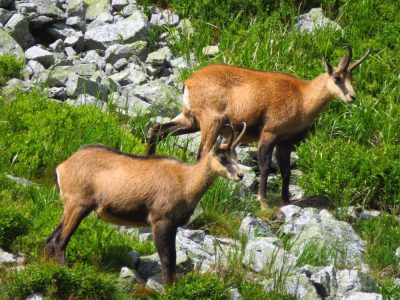
The life of the chamois
The chamois is a species of the high mountains. They are mostly active during the day on the alpine meadows. During winter, they will descend more to the coniferous forests.
Adult males tend to live a solitary life for most of the year whereas female chamois life in herds together with their young. In late autumn, it’s rutting season for the male chamois. On the steep slopes, males fight for their dominance. A chamois can reach up to 17 years of age, which is very rarely the case. The most common causes of mortality are avalanches, deceases and predation. Predation is uncommon, but predators of chamois include Eurasian lynx, wolves, golden eagles and potentially brown bears if they get the chance.
Tatra chamois – Rupicapra rupicapra tatrica
In the Tatra Mountains in Slovakia and Poland, you can find a subspecies of chamois, the Tatra chamois. This subspecies can only be found in the alpine zone of the High Tatras. During the summer months, they are light brown with a darker stripe down the back. However, in autumn they shed this coat and become all dark.
In recent years, the Tatra chamois is doing well. In the past, they had concerns about the survivability of the Tatra chamois populations. As a measurement, they introduced about 30 individuals to the Low Tatras (between 1969-1976). According to recent DNA studies, this population in the Low Tatras crossbred with the Alpine chamois. This means this population can no longer be seen as a pure representation of the subspecies Tatra chamois.
How to observe chamois
The best way to observe chamois is by looking over slopes with your binoculars. They are mostly day active and will graze in areas above the treeline, which makes them easier to spot.
You can always get in contact to see what’s possible. Or you can directly contact the local NGO we are working with (beartracker.sk).
More information about the chamois and its distribution you can find on the IUCN Red List webpage. Wilddocu.de

Wildlife Impulse
Wildlife Impulse started as a blog to share experiences in the world of nature awareness and wildlife conservation.
Wildlife Impulse want to inform you about wildlife in different ways. Explore our website to learn more about it.


